For voucher applicants, ask which rent amount an income test uses
A housing voucher changes the relationship between the full contract rent and the portion a tenant pays. California source-of-income protections matter when a provider applies an affordability test. Learn to identify the denominator in that test and distinguish lawful screening from rejection based on the subsidy itself.
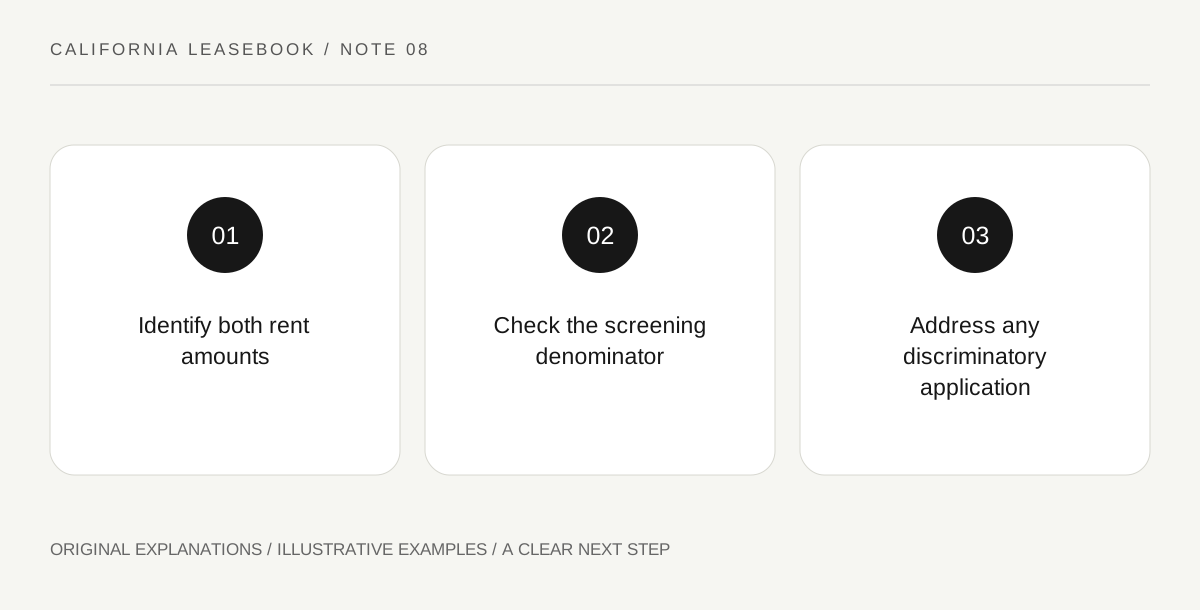
Original explanatory diagram. Read the full method and limitations below.
Separate contract rent from the tenant portion
The full rent for the unit and the amount the household must pay can differ when rental assistance is involved. Obtain the relevant information from the housing agency rather than inventing a subsidy figure from a general formula. For income-to-rent screening, CRD explains that a housing provider may consider only the tenant's portion of rent when applying the standard to a subsidized applicant. A ratio written on a listing should therefore prompt a question about which amount is being used, not an automatic assumption that the full advertised rent is the correct denominator.
Recognize source-of-income discrimination
California protects lawful, verifiable sources of income, including qualifying rental assistance. A categorical no-voucher statement or less favourable treatment because an applicant receives assistance can raise a fair-housing issue. Providers may still use lawful screening criteria; receiving a voucher is not a guarantee of approval for any unit. Keep those ideas separate when discussing an application. Ask for the actual criterion and its application rather than asserting that the subsidy removes every other requirement. Preserve the listing or message if it explicitly rejects assistance.
Ask about non-rent charges separately from the rent share. A parking charge, utility arrangement or optional service can have its own treatment, and an informal total from a listing may not match the agency's approved contract information. Do not quietly add or subtract those items when presenting an income calculation. Show the actual documents to the administering agency and ask what each figure represents. A transparent set of amounts makes it easier to identify a denominator error without claiming that every dollar has identical legal treatment.
Use transparent illustrative arithmetic
Suppose, purely illustratively, that contract rent is 2,400 dollars and the verified tenant portion is 600 dollars. If a provider uses an otherwise lawful income multiple, applying it to 2,400 rather than 600 changes the affordability test substantially. This example does not establish a universally permitted multiple, calculate a household's voucher benefit or decide whether a particular application must be accepted. It shows why the amount used matters. Ask the provider to explain the calculation and confirm the tenant portion with the administering agency.
Keep programme approval and screening distinct
Housing-agency processes can involve unit approval, documentation and other steps in addition to the provider's screening. Ask the agency about its actual timeline and requirements rather than relying on the landlord's description alone. If a provider appears to use a full-rent test or rejects the source of income, seek CRD or qualified legal help promptly. Do not send more private financial records to an unverified recipient in the hope of overcoming a discriminatory statement. A focused inquiry about the criterion can be more useful than an unnecessary personal archive.
The unexplained three-times test
Illustrative example: a listing advertises a rent multiple and a voucher applicant asks whether it will be applied to their agency-verified portion. The written reply says the full unit rent will be used regardless of assistance. The applicant keeps that reply and seeks fair-housing guidance about the specific calculation.
Practical checks
Optional checkboxes save only in this browser.
Questions that come up
Does a voucher guarantee acceptance?
No. Lawful screening and programme requirements can still apply. The provider must not discriminate based on protected income sources or apply an affordability ratio to the wrong rent portion.
Can I calculate my portion from a general online percentage?
Use the administering agency's actual determination for your circumstances. A general example is not a substitute for the verified amount.
References and scope
These sources support the factual background. Examples and exercises are original illustrative teaching material. References do not imply endorsement.
- CRD source of income questions — Voucher protection and tenant-portion income screening.
- CRD source of income fact sheet — Protected lawful income sources and application of affordability criteria to the tenant's share.
- California Civil Rights Department housing guidance — Disability-related housing requests, documentation limits and discrimination protections.