Describe the housing barrier when asking for a disability accommodation
A disability-related housing request often concerns a rule or practice rather than a physical construction project. An assigned parking space, a communication adjustment or a different procedure can raise this issue. Explain the barrier and requested change clearly while sharing only documentation that is legitimately relevant.
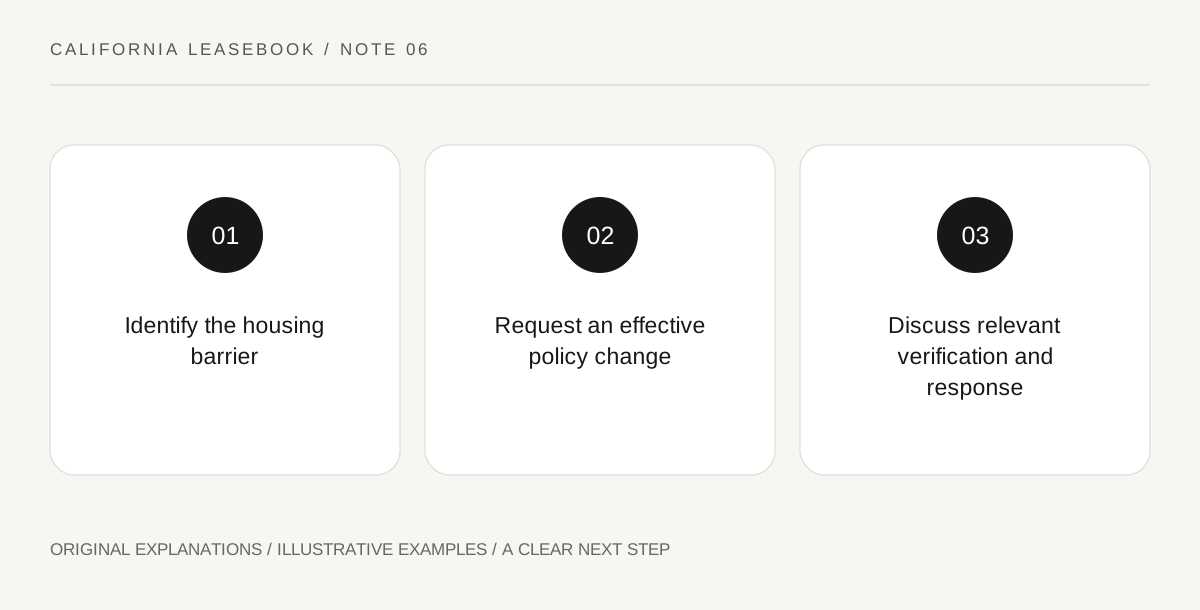
Original explanatory diagram. Read the full method and limitations below.
Identify the policy that creates the barrier
Start with the specific housing rule or practice and how it interferes with equal use and enjoyment of the home because of a disability. A request for an assigned accessible parking location is different from simply preferring the nearest space. A request for accessible communication is different from disliking an employee's tone. Describe the functional connection without writing a full medical history. CRD's 2026 accommodation guidance explains that reasonable accommodations can involve exceptions, changes or adjustments to rules, policies, practices or services.
Make the requested change understandable
A person does not need special legal words to request an accommodation, but a clear written description can reduce misunderstanding. State what change is needed and why it addresses the disability-related barrier. Include a suitable response route and any real timing concern. Avoid demanding that the landlord adopt an unrelated service the housing provider does not ordinarily offer. Reasonableness is assessed in context, and another effective approach may need discussion. The goal is an equal housing opportunity, not a guaranteed right to every preferred arrangement.
Use an example tied to the housing task when the barrier is easy to misunderstand. For a communication request, explain which notices or conversations are difficult to access and what format or support would make them usable. A request to copy a designated helper on relevant communications may be more precise than asking the provider to communicate better. Keep the helper's role and permission clear so the housing provider knows what information can be shared. Precision supports the discussion without requiring disclosure of unrelated personal circumstances.
Keep verification within its proper scope
When the disability and related need are apparent or already known, additional verification may not be necessary. Where verification is legitimately needed, CRD explains limits on the information that can be requested and recognizes reliable sources beyond a physician alone. Do not assume that a provider may demand complete medical records or a diagnosis simply because a request mentions disability. Conversely, do not invent supporting information or buy a generic certificate as a substitute for relevant evidence. Seek fair-housing assistance if a documentation demand seems excessive or unrelated to the requested change.
Distinguish the request from other processes
An accommodation request can matter during an application or an existing tenancy, but it does not automatically cancel a court deadline or resolve every lease dispute. If eviction papers or another notice are involved, obtain advice about both the housing request and the procedural response. Keep the provider's response and any proposed alternative so the discussion is specific. An unexplained refusal or long delay may need CRD or legal assistance. Do not assume that a general no-exceptions policy settles a disability request without an individual assessment.
Parking with a functional explanation
Illustrative example: a tenant explains that a disability limits the distance they can travel and requests an available parking arrangement near the accessible entrance. They describe how that location addresses the barrier, rather than sending an unrelated medical file or asking only for the best space because it is convenient.
Practical checks
Optional checkboxes save only in this browser.
Questions that come up
Must I use the phrase reasonable accommodation?
No specific wording is required, but make clear that a disability-related change to a housing rule or practice is needed.
Is a doctor's letter always mandatory?
No. The need for verification depends on what is apparent or already known, and reliable information is not limited to a physician. CRD guidance explains the limits.
References and scope
These sources support the factual background. Examples and exercises are original illustrative teaching material. References do not imply endorsement.
- California Civil Rights Department housing guidance — Disability-related housing requests, documentation limits and discrimination protections.
- CRD reasonable accommodations, February 2026 — Changes to housing rules or practices, requests and individual reasonableness analysis.