A Tenant Protection Act exemption needs more than a building nickname
Calling a rental a condo, duplex or newer building does not complete the Tenant Protection Act analysis. Exemptions can depend on ownership, occupancy, dates and notice requirements. Separate the rent-limit question from the just-cause question, and then check whether local protections answer either issue differently.
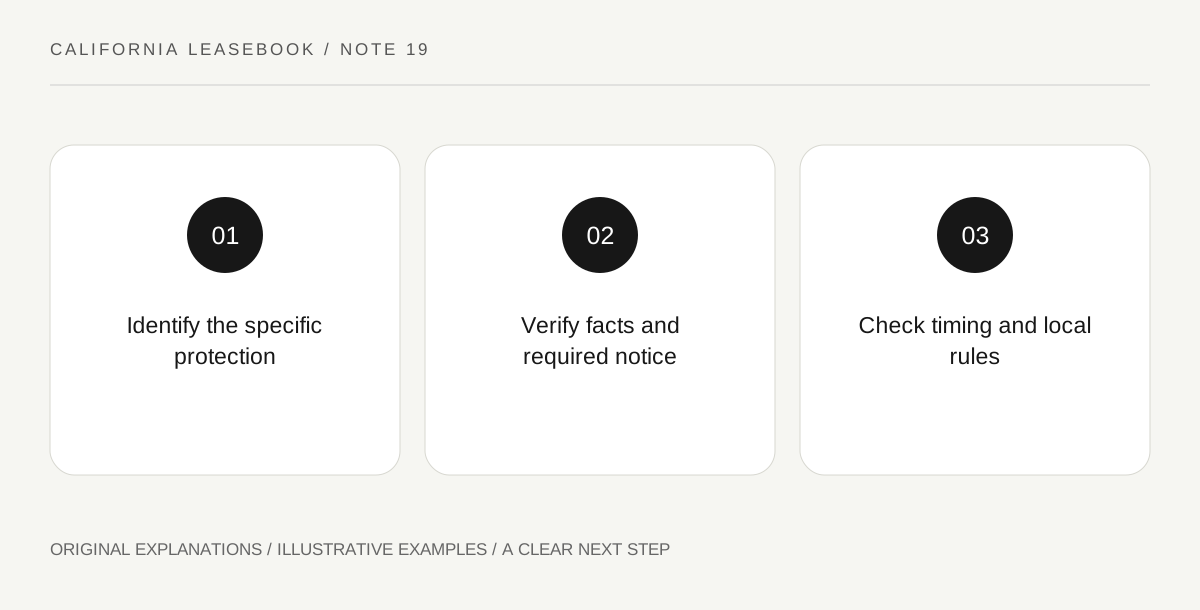
Original explanatory diagram. Read the full method and limitations below.
Identify which protection is being discussed
California's Tenant Protection Act contains rent-increase limits and just-cause termination provisions in different statutory sections. Their application is not always identical, and local rules may provide additional or stronger protections. Ask whether a claimed exemption concerns the rent limit, termination protection or both. A manager's statement that the unit is exempt from rent control can be ambiguous. Avoid converting that phrase into a conclusion that no notice, fair-housing, habitability or other tenant rule applies. An exemption is specific to a rule and set of facts.
Check the actual exemption conditions
The Attorney General and DRE describe categories involving newer construction, certain separately transferable homes, owner-occupied duplexes and other specified housing. Ownership can matter for a single-family home or condominium; a corporation, real-estate investment trust or particular business structure can change the analysis. Owner occupancy can also be a continuing condition rather than a fact established once forever. Obtain relevant information through legitimate sources and mark uncertain facts as unresolved. Do not decide from a rental listing's condo label or the number of front doors visible from the street.
Do not confuse a certificate-of-occupancy date with a renovation date or an advertisement calling the apartment newly built. Those facts can refer to different events, and a fresh kitchen does not establish the age used by a statutory exemption. Ask what official record supports the asserted date and whether the specific unit is the one described. Likewise, a tax or business mailing address does not alone establish continuing owner occupancy. A precise coverage inquiry should identify which fact remains unverified rather than accepting a convenient proxy for it.
Read the required exemption notice
For qualifying single-family-home and condominium exemptions, DRE explains that the specified written notice or rental-agreement term is necessary for the exemption to operate. Find the actual wording and date instead of assuming an informal conversation suffices. A notice also cannot create an exemption when the substantive property or ownership conditions are absent. Have qualified help assess both the facts and the required notice. Avoid signing an inaccurate new acknowledgement under pressure merely because it is described as routine paperwork. Ask what legal proposition you are being asked to acknowledge.
Reassess changes and the local layer
A rolling newer-construction period changes as a building ages, while ownership or owner occupancy can change over time. Keep the relevant event dates separate from the tenancy start. For just-cause protection, occupancy-duration rules can introduce another timing question. Local law may protect a unit even where a particular state exemption applies. If a rent increase or termination notice is already pending, obtain prompt advice without assuming the coverage discussion suspends its deadline. The aim is a rule-specific conclusion supported by the actual facts, not a universal exempt or covered badge.
A condo owned through a business
Illustrative example: a rental agreement calls the unit a condo and declares it exempt. The tenant asks qualified help to examine ownership and the required notice, then checks local protections. The physical form of the unit does not settle every condition needed for the claimed exemption.
Practical checks
Optional checkboxes save only in this browser.
Questions that come up
Does an exemption notice alone make the unit exempt?
No. The substantive conditions must also be satisfied. Wording cannot create ownership or property facts that are absent.
Does state exemption eliminate local protection?
Not automatically. Check the applicable city or county rules separately, because their scope and requirements can differ.
References and scope
These sources support the factual background. Examples and exercises are original illustrative teaching material. References do not imply endorsement.
- California DRE tenant guide, 2026 edition — Current state guidance on entry, repairs, payment, survivor termination, photographs and tenancy categories, with statutory references.
- California Attorney General landlord-tenant issues — Prohibited lockouts, Tenant Protection Act scope, local overlays and fair housing.