Renting one room does not automatically make someone a single lodger
A room rental can involve an ordinary tenancy, a subtenancy or California's narrow single-lodger category. The label on an advertisement does not decide it. Look at ownership, actual occupancy and control of the home before applying a simplified rule that may not fit the arrangement.
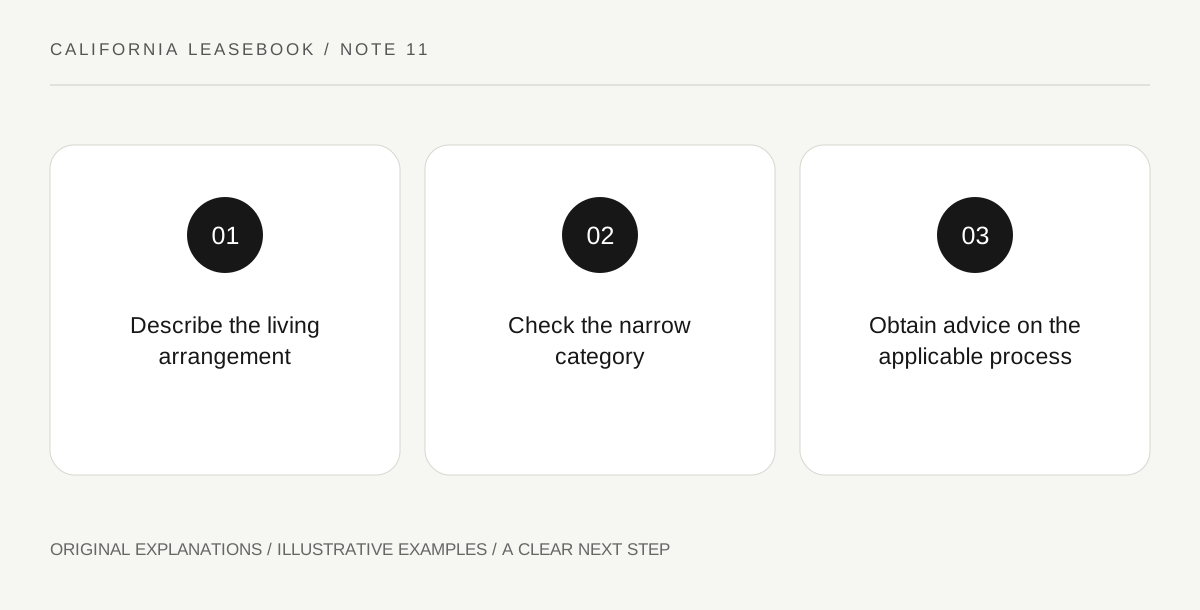
Original explanatory diagram. Read the full method and limitations below.
Describe who actually lives in the home
California Courts describes a possible lodger situation where an owner rents one room in the owner's home to one person. The DRE guide adds the owner's occupancy and overall control of the home to the explanation. Write down the actual arrangement: who owns the property, where the owner lives, who else rents space and which areas are under whose control. A manager living nearby is not automatically the resident owner. Nor does sharing a kitchen with other renters establish the special category by itself.
Understand why the distinction matters
Most lodgers have rights similar to tenants, but the narrow single-lodger rule can affect how an occupancy is ended. It should not be extended to a house with several room renters merely because each has a separate agreement. California Courts warns that local law-enforcement practice and disputes about status can affect what happens, and a formal eviction action may still be needed. This guide is for recognizing a classification issue, not instructions for removing someone. Both the occupant and owner should obtain qualified advice before relying on a shortcut.
Consider who controls access to the rented room in practice, and describe that accurately when seeking advice. Exclusive possession of a separate dwelling, a lockable room within a shared house and an owner retaining access to the lodger's areas are not interchangeable facts. Do not change locks or alter the arrangement merely to create evidence for a preferred category. Provide the agreement and a straightforward account of how the household has actually functioned. Classification should be assessed from real circumstances, not a newly staged version of them.
Keep labels separate from evidence
A contract can use tenant, roommate, guest or lodger while the legal analysis depends on the facts and applicable law. Save the agreement and any explanation of the living arrangement, but do not assume a signature settles every classification question. An existing tenant offering a spare room is a different fact pattern from an owner occupying the home and renting to one person. Likewise, an owner's temporary absence can raise questions that should be assessed rather than answered with a guessed number of nights away.
Do not turn uncertainty into force
If a notice claims that someone is a lodger and must leave through a simplified process, seek prompt legal help with the full agreement and occupancy facts. Do not ignore it because the word seems wrong, and do not assume that changing locks or physical removal is justified by the owner's chosen label. Timing, notice and local practice still matter. A household disagreement about shared facilities is not a substitute for deciding the legal status. Keep personal safety and any court deadline separate from the classification discussion.
Two separately rented bedrooms
Illustrative example: an owner lives in a house and rents two bedrooms to two unrelated people under separate contracts. One contract says single lodger. The occupants do not assume that wording creates the narrow one-lodger exception; they obtain advice based on the actual number of renters and living arrangement.
Practical checks
Optional checkboxes save only in this browser.
Questions that come up
Does sharing a bathroom prove lodger status?
No. Shared facilities alone do not establish the narrow category. Ownership, occupancy, control and the number of lodgers matter.
Can an agreement's label settle the issue?
Not by itself. A legal adviser must consider the actual arrangement and applicable rules, particularly if status is disputed.
References and scope
These sources support the factual background. Examples and exercises are original illustrative teaching material. References do not imply endorsement.
- California Courts: single lodgers — Narrow owner-occupied single-lodger category and the importance of actual living arrangements.
- California DRE tenant guide, 2026 edition — Current state guidance on entry, repairs, payment, survivor termination, photographs and tenancy categories, with statutory references.