A foreclosure notice for the owner is not automatically a tenant's move-out order
Tenants can receive alarming foreclosure papers even though they did not borrow the money. The owner's loan process and the tenant's possession rights are different questions. Identify the stage of foreclosure, the lease and any tenant-specific notice before assuming that a sale requires immediate departure.
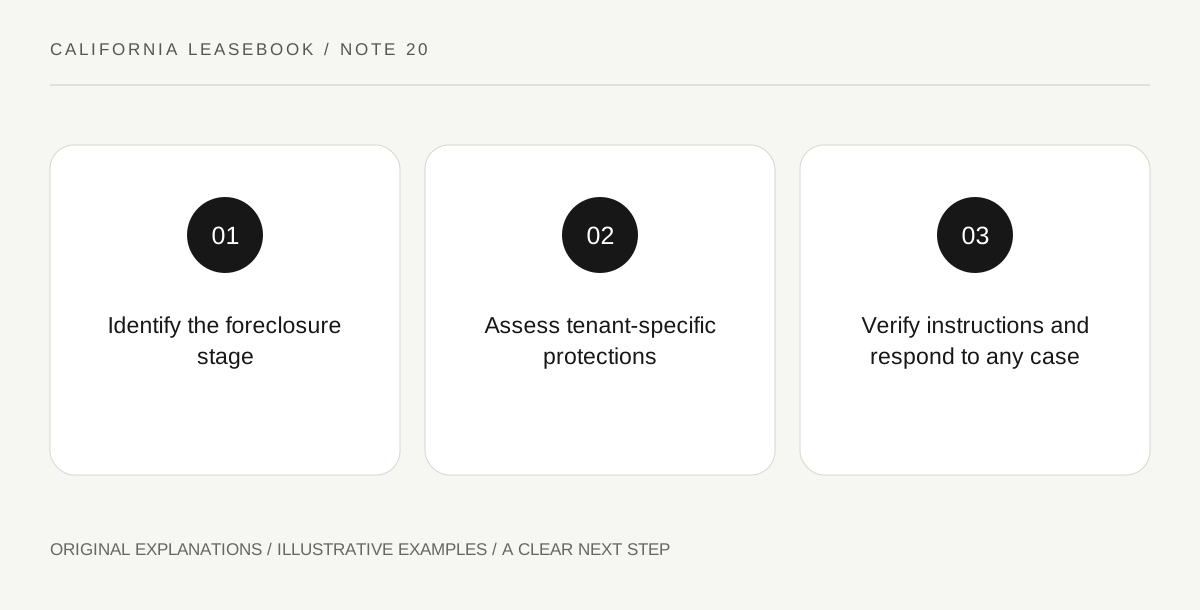
Original explanatory diagram. Read the full method and limitations below.
Recognize whose obligation the paper concerns
Look at the document title, addressee and stated action. A notice about the owner's mortgage default or a scheduled foreclosure sale is not necessarily a summons in an eviction case against the tenant. Keep all pages and promptly obtain help identifying the stage. Do not pay a stranger claiming to save the property or redirect rent based solely on an unverified message. At the same time, do not ignore the paper because your name is absent; it can signal an upcoming ownership change that affects where future instructions should come from.
Check the tenant's lease and statutory protections
California Courts explains that tenants generally have a ninety-day notice protection after foreclosure and that a fixed-term lease may need to be honoured, subject to exceptions. The analysis can involve whether the tenancy is bona fide, when the agreement began, the purchaser's intended occupancy and other facts. A family relationship to the former owner or a non-arm's-length arrangement can matter. Do not apply the same rule to the foreclosed homeowner as to an unrelated renter. Give the adviser the actual lease and occupancy history rather than only the new owner's preferred summary.
Keep homeowner advice out of the tenant analysis unless it actually applies to your role. Mortgage reinstatement, loan modification and a borrower's redemption rights concern different relationships from an unrelated renter's lease. A search result using the word foreclosure may describe the former owner's short notice period rather than a tenant's protection. Start from the California Courts tenant guidance and identify who occupies the property in what capacity. This prevents an alarming but inapplicable paragraph from becoming the household's assumed deadline.
Verify the new payment and management instructions
Continue treating rent obligations as a separate issue while determining the legitimate recipient and any applicable change. Request reliable ownership or management information through an independently verified route before sending money to a new account. Keep proof of what was paid and to whom. A foreclosure does not automatically make a tenant's rent optional or authorize paying both competing claimants without advice. Deposit responsibility and any programme contract can raise additional questions. If a housing voucher is involved, notify the administering agency and ask about the programme-specific process.
Require the appropriate possession process
A purchaser who wants possession must use the applicable notice and court process; an assertion that the bank now owns the property is not by itself a lockout authorization. If tenant-directed termination papers or an eviction lawsuit arrive, obtain qualified help promptly and address the relevant deadline. Do not sign a surrender or cash-for-keys agreement without understanding what protections and claims it may affect. A negotiated departure can be a separate choice, but it should be evaluated against the actual tenancy position, payment terms and practical housing needs.
A notice addressed to the borrower
Illustrative example: an unrelated tenant finds a foreclosure-sale notice addressed to the owner. They take it and their lease to qualified help, verify the stage and ask about tenant-specific protections. They do not assume the sale date is their move-out deadline or send rent to an unverified caller claiming to represent the bank.
Practical checks
Optional checkboxes save only in this browser.
Questions that come up
Does every tenant have to leave on the sale date?
No. Tenant-specific notice and lease protections can apply. Exceptions and the actual tenancy facts require qualified assessment.
Does foreclosure automatically stop my rent obligation?
Do not assume so. Determine the legitimate recipient and applicable duties with qualified help, particularly when conflicting payment demands appear.
References and scope
These sources support the factual background. Examples and exercises are original illustrative teaching material. References do not imply endorsement.
- California Courts: tenant rights in foreclosure — Tenant-specific foreclosure protections, fixed-term leases, notice and court process.
- California DRE tenant guide, 2026 edition — Current state guidance on entry, repairs, payment, survivor termination, photographs and tenancy categories, with statutory references.
- California Courts: tenant notice types — Different pre-lawsuit notices, their purposes and programme-specific differences.