Early termination after abuse involves a specific notice and evidence route
California provides a statutory early-termination route for tenants affected by specified abuse or violence. It can differ sharply from an ordinary lease-break clause. Learn the categories of questions to raise with an advocate or lawyer while protecting privacy and separating immediate safety needs from the paperwork.
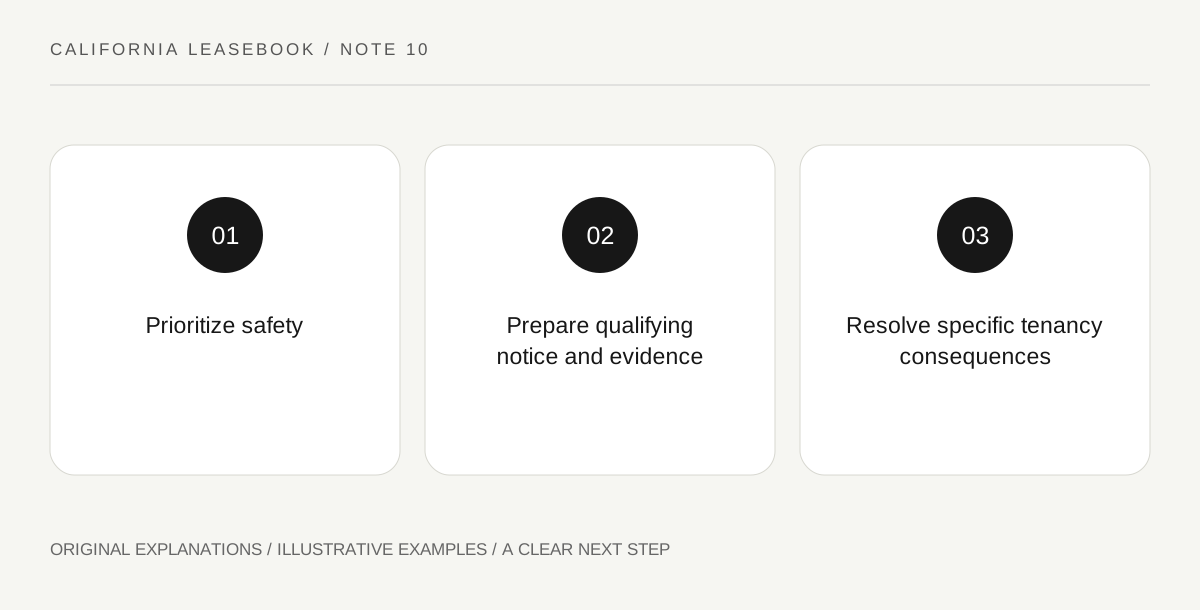
Original explanatory diagram. Read the full method and limitations below.
Begin with safety and the covered situation
If someone is in immediate danger, seek appropriate emergency assistance and a safe setting before trying to complete tenancy paperwork. California's DRE guide describes early termination protections for specified circumstances, including domestic violence, sexual assault, stalking, human trafficking and elder or dependent-adult abuse affecting a tenant or household member. This is a legal eligibility question, not something a landlord should settle through informal judgment about whether an experience was serious enough. A qualified survivor advocate or lawyer can help assess the actual facts and available protections.
Use the statutory notice route carefully
The guide explains a written notice stating the intention to terminate under the applicable protection, accompanied by qualifying documentation. It describes alternatives including certain court orders, police reports and statements from qualified third parties, with relevant timing rules. Do not assume a police report is the only possible route or that any informal note automatically qualifies. Ask an advocate about the appropriate document and how to deliver it safely. Keep copies in a place the person causing harm cannot access, using a safe communication method for replies.
Plan a safe route for receiving the response before sending sensitive evidence. A shared email account, household mail slot or device monitored by the person causing harm can expose the request or a new address. Tell the advocate about those practical risks and ask how the notice and contact information can be handled appropriately. The objective is not to avoid the required process, but to complete it without casually disclosing information that creates another danger. A private copy should remain available to the tenant or their trusted adviser.
Distinguish the limited rent period from other accounts
DRE describes responsibility for rent for fourteen days following the qualifying notice, subject to the rule concerning earlier re-rental. That is different from an ordinary demand for rent through the entire remaining fixed term or a standard lease-break penalty. It does not mean that every unrelated lawful obligation or deposit issue disappears. Discuss unpaid rent, damage claims and household members' positions separately with qualified help. Do not sign a broad release just because a manager offers to describe the departure as a voluntary move.
Ask about confidentiality and people remaining
Sensitive documentation should be handled under the applicable privacy protections; it should not become a general building announcement. Ask the advocate or lawyer about disclosure limits and a safe forwarding or contact arrangement. If another tenant remains, the consequences for that person's tenancy need separate assessment. An early-termination notice is also different from a protective order, a request to change locks or an emergency safety plan. Several protections may be relevant, but completing one process does not automatically complete the others. Avoid relying on a generic move-out checklist for this situation.
An ordinary penalty clause is quoted
Illustrative example: a tenant considering a protected early termination is shown a lease clause requiring two months' rent to break the agreement. They consult a qualified advocate about the statutory notice and evidence route before accepting that charge. They keep safety planning separate from the manager's ordinary departure form.
Practical checks
Optional checkboxes save only in this browser.
Questions that come up
Is a police report always required?
The official guide describes other qualifying documentation routes, including specified court orders and qualified third-party statements. Obtain help choosing the appropriate route for your facts.
Does a standard lease-break fee automatically apply?
Do not assume it does when a statutory protection applies. Have qualified help assess the notice, evidence and claimed charge before agreeing to pay.
References and scope
These sources support the factual background. Examples and exercises are original illustrative teaching material. References do not imply endorsement.
- California DRE tenant guide, 2026 edition — Current state guidance on entry, repairs, payment, survivor termination, photographs and tenancy categories, with statutory references.