Repair and deduct is a limited remedy, not a general renovation budget
Paying a contractor and subtracting the bill from rent can create a nonpayment dispute if the legal conditions are not met. California's repair-and-deduct remedy has specific limits. Understand the decision points before spending money, and get help assessing the condition rather than treating every unfinished repair as permission.
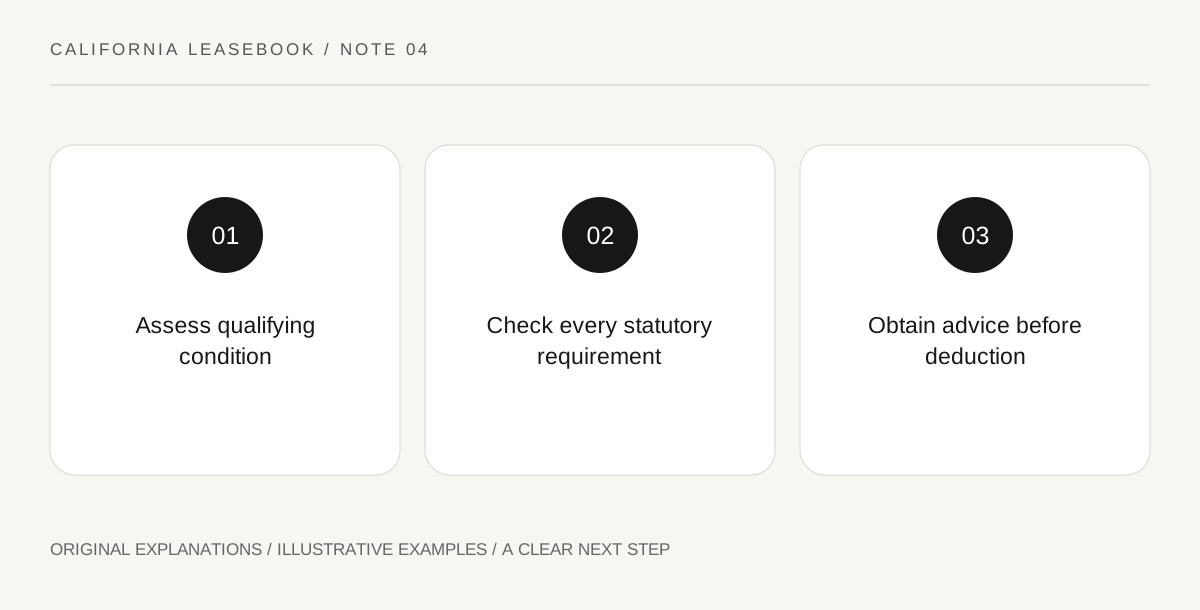
Original explanatory diagram. Read the full method and limitations below.
Distinguish the remedy from a repair request
Reporting a broken item asks the landlord to address it. Repair and deduct is a separate legal remedy that may be available for serious conditions directly affecting health and safety after the required notice and opportunity to act. A cosmetic preference, optional improvement or ordinary inconvenience does not automatically qualify. The DRE guide recommends obtaining legal advice before proceeding because the remedy involves technical requirements. Describe the condition and its actual effects so an adviser can assess the legal category instead of relying on the label urgent.
Check all conditions, not only price
The guide describes a cost limit of one month's rent and a frequency limit of twice in a twelve-month period, along with other requirements. Those figures are ceilings, not a grant to spend that amount on any problem. Responsibility for causing the defect, notice to the landlord and a reasonable time to repair also matter. Do not divide one project into several invoices to make it appear eligible. If a quote exceeds a limit, that raises a different remedies question; it does not justify subtracting a smaller arbitrary portion from rent.
Separate the legal permission to deduct from permission to perform the work. Even a potentially qualifying defect may involve licensed work, permits, building systems or access to other units. Do not open wiring, disturb suspected hazardous materials or interfere with a shared utility in order to keep a quote below the limit. Ask a qualified professional about the work and a housing adviser about the remedy. These are different judgments, and a low contractor estimate cannot substitute for either of them.
Reasonable time depends on the circumstances
The law's timing framework is not permission to wait through an immediate danger, nor does it mean every nonemergency must be completed by the next morning. A qualified adviser can consider the seriousness, access, parts and notice history. Use emergency or utility services for immediate hazards rather than attempting a dangerous repair. Keep professional assessment separate from your own observations. A contractor's availability can help explain practical timing, but the contractor does not decide whether the tenant may lawfully deduct a charge from rent.
Consider the consequence of a wrong deduction
If the condition or procedure does not qualify, the landlord may claim unpaid rent and pursue collection or eviction. Retaliation protections do not remove the need to establish the remedy's requirements. Before any deduction, discuss the evidence, estimate, prior use of the remedy and alternatives with qualified legal help. If a deduction is lawfully made, retain the actual bills and explanation. Avoid treating withholding all rent as the same remedy; withholding and repair-and-deduct have different legal analysis and risks.
An affordable cosmetic change
Illustrative example: replacing a stained but functional cabinet door would cost less than one month's rent. The tenant learns that price alone does not make it a repair-and-deduct case. They pursue the repair request and obtain advice about actual obligations rather than subtracting the contractor's bill automatically.
Practical checks
Optional checkboxes save only in this browser.
Questions that come up
Is a bill below one month's rent automatically deductible?
No. The cost cap is only one condition. The nature of the defect, notice, timing and other requirements still need to be satisfied.
Can I withhold all rent instead?
Do not assume the remedies are interchangeable. Rent withholding requires its own legal assessment and can expose a tenant to a nonpayment case if used incorrectly.
References and scope
These sources support the factual background. Examples and exercises are original illustrative teaching material. References do not imply endorsement.
- California DRE tenant guide, 2026 edition — Current state guidance on entry, repairs, payment, survivor termination, photographs and tenancy categories, with statutory references.