Court eviction papers start a different clock from a landlord's notice
A landlord's notice and a summons with an unlawful-detainer complaint are different documents. Once a court case is served, waiting for another reminder can have serious consequences. Learn to recognize the transition, confirm the service-dependent deadline and use the current California Courts instructions promptly.
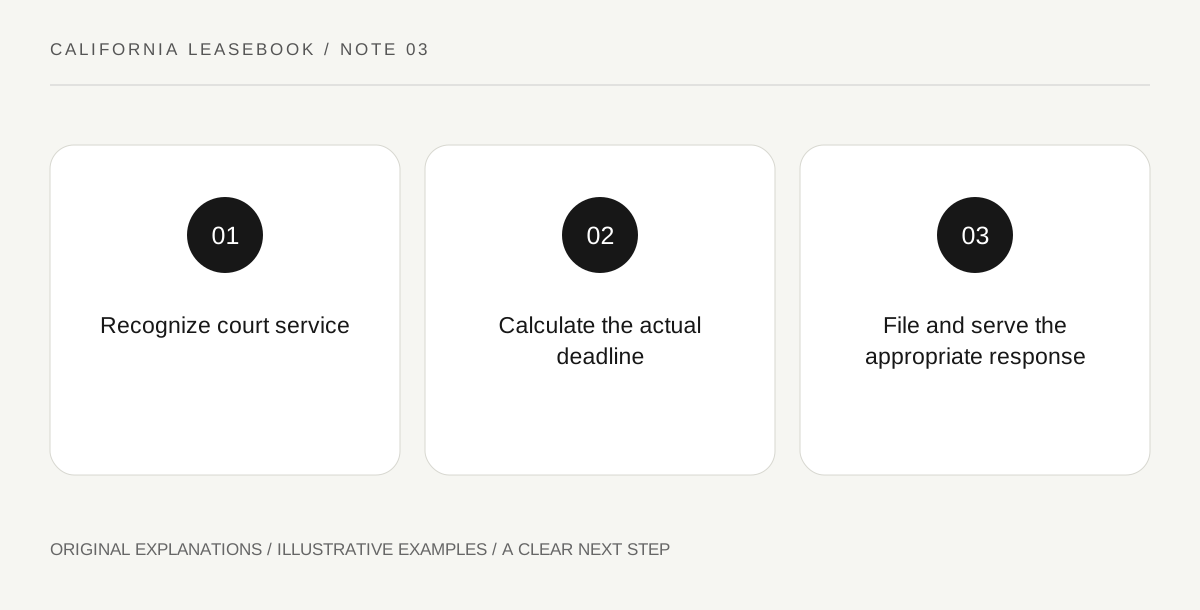
Original explanatory diagram. Read the full method and limitations below.
Identify the packet you received
Look for the court name, case number, summons and complaint, keeping all pages together. A notice to pay rent or move out generally precedes a lawsuit; court papers mean a case has been filed. Do not assume that a familiar landlord logo makes a document informal or that an unsigned copy can be ignored. Record how and when the packet reached you, including delivery to another person or later mailing. Those facts can affect the calculation and should be shown to the court self-help centre or a lawyer.
Use the current response rule
California Courts currently explains that a tenant generally has ten court days to file an Answer after service of eviction papers. Court days exclude weekends and court holidays, but the starting point depends on the method of service; substituted or court-authorized posted service can involve additional calendar-day steps. Do not use an old five-day article or simply add ten days to the day you noticed an envelope. Ask for help calculating the actual deadline from the complete service facts and the current court calendar.
Read the names on the case as well as the address. Occupants not named in a lawsuit can face separate procedural questions, and a paper addressed to one household member may still matter to others. Do not alter names on a form casually or assume that one person's response necessarily protects every occupant. Show the full packet and household circumstances to qualified help. This is especially important when a tenant is away temporarily and another person receives papers but delays telling them because the envelope seemed personal.
Filing and serving are distinct tasks
The official response process explains completing the appropriate forms, filing with the court and arranging service of the response on the other party. A tenant cannot assume that emailing an explanation to the landlord accomplishes those procedural tasks. Ask the self-help centre about local filing methods, fees, a fee waiver and the service requirements. Keep filed copies and proof of service. If a form asks for legal defenses, obtain help applying them to your facts rather than checking every box in the hope that more boxes provide more protection.
Negotiation does not automatically pause the case
A conversation about payment or moving can be useful while the lawsuit is pending, but do not assume it extends the filing deadline. Ask whether any agreement has been properly documented and what happens to the court case. Missing the response deadline can allow a default judgment without your side being considered. If you think a deadline has already passed, seek urgent help rather than deciding there is nothing to do. An adviser can assess available procedural options; this guide cannot promise that a late response will be accepted.
A payment discussion continues
Illustrative example: a tenant receives a summons while discussing a payment plan with the manager. They bring the complete packet and delivery details to court self-help the same day and confirm the response steps. They continue negotiations without treating the conversation as a court-approved extension.
Practical checks
Optional checkboxes save only in this browser.
Questions that come up
Is replying to the landlord enough?
No. A court case requires the appropriate court response and service procedure. Use current official instructions and obtain help promptly.
Are ten court days the same as ten calendar days?
No. Weekends and court holidays are treated differently, and service method can affect when the clock starts. Confirm the exact calculation for your case.
References and scope
These sources support the factual background. Examples and exercises are original illustrative teaching material. References do not imply endorsement.
- California Courts: responding to an eviction case — Current Answer deadline, service-dependent calculation and response procedure.
- California Courts: tenant notice types — Different pre-lawsuit notices, their purposes and programme-specific differences.