San Francisco deposit interest follows its own annual due date
A San Francisco security deposit can raise a local interest question separate from the eventual refund of the principal. The relevant rate period, annual due date and coverage need to be identified. Do not use a statewide deposit-cap summary or an arbitrary calendar year to calculate a local interest account.
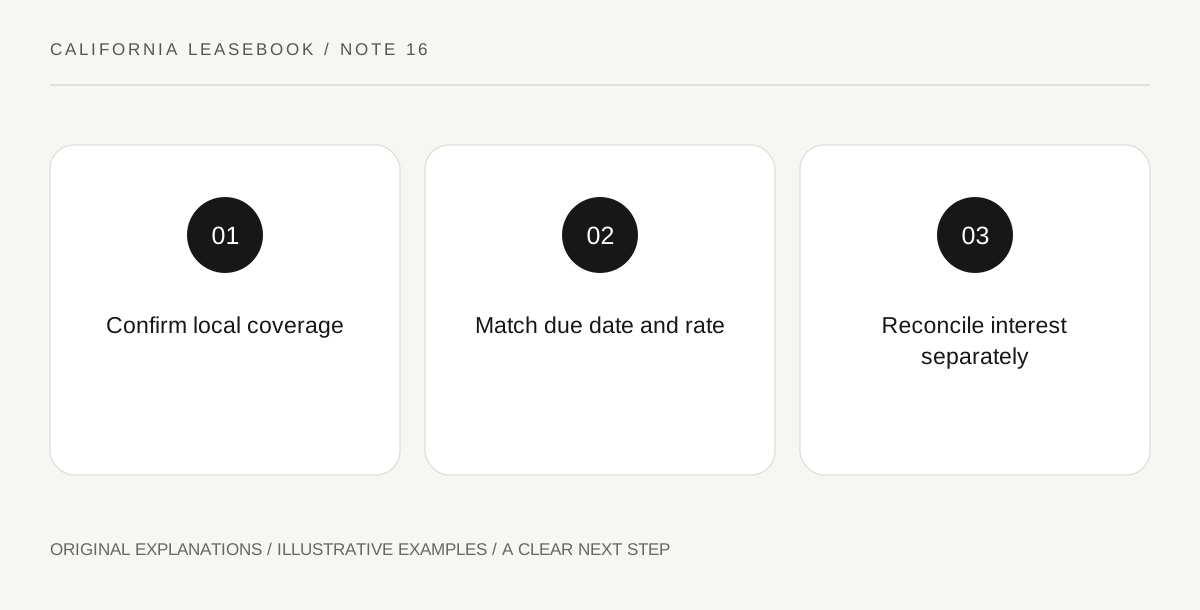
Original explanatory diagram. Read the full method and limitations below.
Confirm the local interest rule applies
San Francisco's local security-deposit interest rules are distinct from California's general deposit-limit and return rules. The local code addresses deposits held for at least one year and includes exceptions, including certain government-assisted rents. Do not decide the interest question solely from whether the unit has rent-increase protection. Ask the Rent Board about the actual housing and assistance arrangement if coverage is uncertain. A landlord's statement that a building is exempt from one ordinance does not automatically answer every local deposit-interest question.
Identify the annual due date and matching rate
The Rent Board publishes an interest-rate schedule with effective periods and explains the tenant's annual due date. A rate period beginning in March is not identical to January through December. Locate the due date that applies to the account and the published rate in effect for that calculation. Do not average two rates just because part of the year falls in each published period unless official instructions call for that method. Keep the rate schedule for each relevant year, since using today's rate for every past year can produce a misleading total.
Use one row per annual interest event rather than one row per month of occupancy. Record the principal used, the official rate period, the gross result and how any payment was made. If a deposit amount changed lawfully, identify the change separately and ask how it affects the calculation. This prevents a spreadsheet from hiding an assumption that the original principal remained constant forever. A landlord's own bank interest is also not a substitute for the local prescribed method; the relevant question is what the ordinance requires for the tenancy.
Use a transparent simple-interest calculation
For an eligible full-year example, multiply the relevant deposit principal by the applicable annual rate using the official method. As purely illustrative arithmetic, a 2,000-dollar principal at a hypothetical four-percent annual rate produces 80 dollars before any lawful adjustment. This is not a quote of the current rate or a decision about a particular tenancy. Keep principal, gross interest, any permitted offset and payment or credit in separate columns. Do not automatically compound unpaid interest or silently add it to the deposit principal; ask the Rent Board about the correct treatment.
Separate annual interest from the move-out account
At move-out, a partial-year interest question may arise in addition to return of principal and lawful deductions. Ask about the applicable proration and rate rather than inventing a monthly amount. If a landlord applies a Rent Board fee offset, identify the year, amount and legal basis separately. A credit against rent should be documented clearly so it does not later look like an unexplained underpayment. If the parties disagree, use the Rent Board's current guidance and qualified legal advice about the appropriate recovery process, keeping the interest calculation distinct from a dispute about physical damage.
The wrong calendar column
Illustrative example: a tenant has a September annual due date but calculates interest using a January-to-December spreadsheet. They rebuild the account around the official annual due date and corresponding published rate period. They list any payment already received separately so a corrected calculation does not count the same interest twice.
Practical checks
Optional checkboxes save only in this browser.
Questions that come up
Can I apply the latest rate to every earlier year?
Do not assume so. Match each relevant due date and period to the official schedule and calculation method.
Is deposit interest the same as the deposit refund?
No. Interest is a separate local accounting question; principal return and deductions have their own requirements. A move-out account may need both.
References and scope
These sources support the factual background. Examples and exercises are original illustrative teaching material. References do not imply endorsement.
- San Francisco security deposit interest rate schedule — Annual due date and rate periods, including March 2026 to February 2027.
- San Francisco Administrative Code Chapter 49 — Simple interest, one-year holding condition and local interest structure.