The 2025 deposit-photo rules create several different evidence moments
A deposit dispute can involve photographs taken at the start of a tenancy, after possession returns and after cleaning or repair. Those images answer different questions. California's 2025 changes make it useful to identify which stage a photograph records instead of treating any picture as proof that a charge is justified.
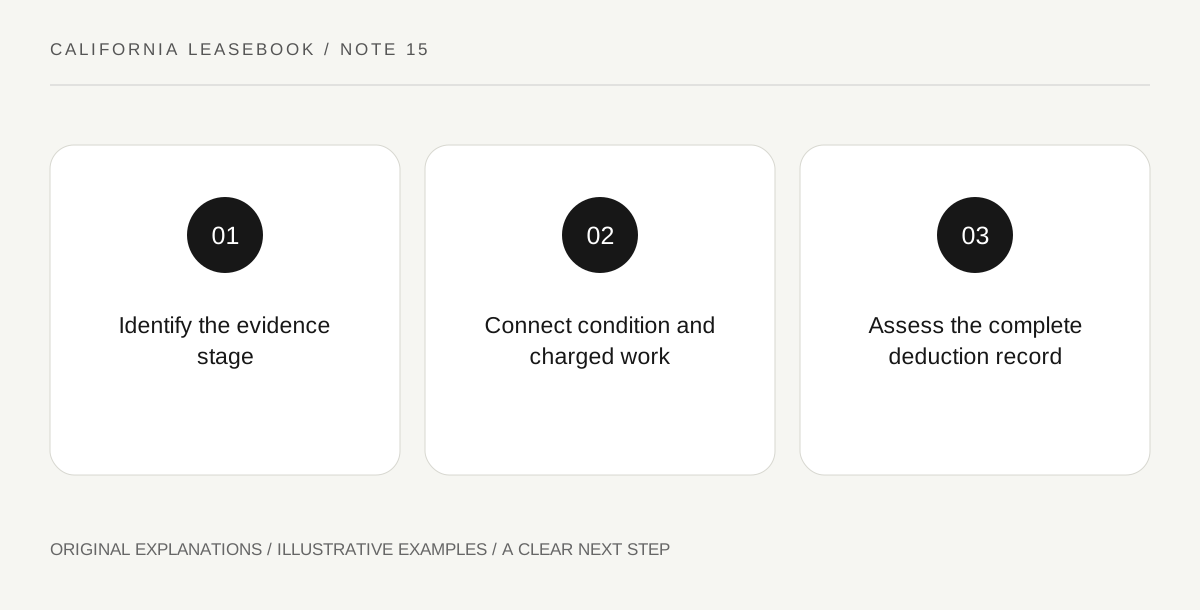
Original explanatory diagram. Read the full method and limitations below.
Distinguish the beginning-of-tenancy requirement
The DRE guide explains that, for tenancies beginning on or after July 1, 2025, landlords must photograph the unit immediately before or at the beginning of the tenancy. That creates a particular baseline obligation, not a reason for tenants to abandon their own condition record. Ask for copies and identify the date and area each image shows. A photograph taken after furnishings cover a surface may not answer the same question as a clear pre-occupancy image. Do not claim an image proves something outside its visible frame.
Identify the post-possession, pre-work stage
Beginning April 1, 2025, the guide describes landlord photographs within a reasonable time after possession is returned and before repairs or cleaning. These images concern condition at the end of occupancy before work changes it. Keep that stage separate from an earlier requested pre-move-out inspection, which can occur while possessions remain and serves a different process. Ask which stage supplied images represent. A final photograph showing a newly painted wall cannot by itself establish what condition required painting before the work began.
Read filenames as clues rather than proof of when a photograph was taken. An exported file can acquire a new name or date, and a screenshot may omit the original context. Preserve the copies supplied, ask for clarification of their stage and location, and compare them with other records instead of accusing someone solely from a filename mismatch. The useful question is what condition each image reliably shows. A small, well-labelled set can explain the dispute better than hundreds of duplicated pictures with no connection to the charged item.
Connect after-work images to the specific deduction
The rules also address photographs after cleaning or repairs and provision of relevant photographs with the explanation of deductions. Compare the location and work described across the stages. The presence of an after-work photograph does not independently prove that the tenant caused damage, that it exceeded normal wear or that the full cost is allowable. Similarly, a photograph of dirt does not establish an unexplained invoice total. Ask how the condition, permitted charge and documented cost connect without treating one piece of evidence as the whole analysis.
Raise a precise evidence question
If a required stage appears missing, ask for that specific material and retain the response. Avoid editing the original pictures or stripping context when sending copies to an adviser. A qualified legal resource can assess the consequences of missing photographs, timing and other deposit requirements for the actual tenancy; this article does not promise an automatic full refund for every omission. Keep your own baseline, move-out images, itemized statement and relevant cost documents together so the comparison can be made room by room and charge by charge.
Only the repaired surface is shown
Illustrative example: a deduction statement includes a photograph of a freshly repaired door but no clear pre-work image. The tenant asks for the relevant earlier photograph and explanation connecting the claimed damage to the charge. The shiny finished surface does not establish the condition that existed when possession returned.
Practical checks
Optional checkboxes save only in this browser.
Questions that come up
Is the pre-move-out inspection the same as the pre-work photo stage?
No. They occur in different circumstances and serve different purposes. Identify which event and date each record belongs to.
Does an after-work photograph prove the deduction is lawful?
No. Causation, normal wear, permitted purposes, cost and procedural requirements remain relevant alongside the image.
References and scope
These sources support the factual background. Examples and exercises are original illustrative teaching material. References do not imply endorsement.
- California DRE tenant guide, 2026 edition — Current state guidance on entry, repairs, payment, survivor termination, photographs and tenancy categories, with statutory references.