An evacuation order ending does not settle a rental's disaster condition
A building may still contain smoke residue, ash or other disaster debris after a neighbourhood reopens. California's 2026 disaster rules distinguish access to an area from the condition of a rental home. Ask about official determinations and remediation rather than treating a quick visual cleanup as proof of habitability.
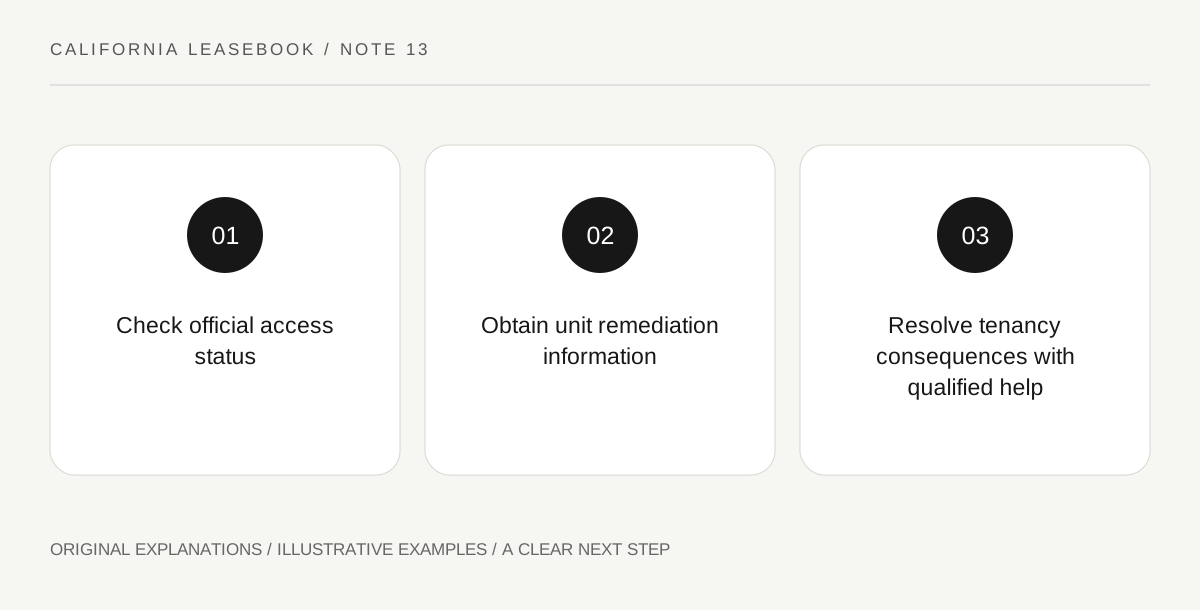
Original explanatory diagram. Read the full method and limitations below.
Separate area access from unit condition
A lifted evacuation order concerns whether people may return to an area under the relevant emergency instructions. It does not automatically answer whether an individual rental contains hazardous debris or has functioning systems. Follow official safety directions and avoid entering restricted or unsafe premises. DRE's 2026 guide describes a presumption concerning disaster debris until a local public-health agency or official determines that it does not contain toxic substances. A unit's appearance or a neighbour's return cannot replace the applicable official assessment.
Understand the landlord's remediation role
The current guidance describes a landlord's duty to address disaster-related disrepair, including debris and hazards such as smoke residue, ash, mold or water damage, within the applicable reasonable-time framework and official cleaning protocols. A tenant should not be expected to decide from smell alone whether remediation is complete. Ask what work was performed, which areas were addressed and what official instructions apply. Do not disturb debris, open damaged systems or undertake hazardous cleanup yourself to make the unit seem ready for occupancy. Appropriate professionals and public agencies have distinct assessment roles.
Ask whether the document refers to your unit, a common area or only a sample location. A report about one cleaned corridor cannot automatically describe a different apartment, and a preliminary inspection can have a different purpose from a completion assessment. Record the report's stated scope without trying to interpret laboratory values yourself. If the manager relies on a building-wide statement, ask the responsible agency or qualified professional what it establishes for the unit you would occupy. A careful scope question can expose a gap without inventing a contamination diagnosis.
Request the relevant reports and notification
The guide explains notification and access to environmental studies, tests and reports conducted concerning remediation when the tenant has provided a postal or email address. Ask for the actual documents rather than an unsupported statement that everything passed. A laboratory report can have a limited scope, location and date; it should not be generalized to areas it did not assess. If technical language is unclear, ask the responsible public-health authority or a qualified professional to explain it. Preserve both the completion notice and the supporting information.
Separate rent, return and property-loss questions
SB 610 also addresses rent during mandatory evacuation and other disaster consequences, but the exact facts and dates matter. Obtain qualified help about rent accounting, destruction of the premises, return rights and any temporary relocation arrangement rather than assuming one rule answers all of them. An insurer's claim decision is another process and does not itself establish habitability. Keep the evacuation period, access dates and remediation timeline distinct. If a proposed agreement includes a permanent surrender or release, get advice before signing while under pressure to secure temporary shelter.
The street reopens first
Illustrative example: a tenant is told the evacuation restriction has ended, but the rental still contains ash. They follow public safety directions, ask about the unit-specific public-health determination and request remediation reports. They do not treat the reopened street as a certificate that the home's interior is ready.
Practical checks
Optional checkboxes save only in this browser.
Questions that come up
Does a clean-looking room establish safe return?
No. Appearance alone does not settle disaster contamination or the current legal habitability question. Use the relevant official and qualified assessment.
Can an insurance payment decide whether rent is owed?
Not by itself. Insurance coverage, evacuation rent rules and tenancy obligations are different questions that require their own facts and guidance.
References and scope
These sources support the factual background. Examples and exercises are original illustrative teaching material. References do not imply endorsement.
- California DRE tenant guide, 2026 edition — Current state guidance on entry, repairs, payment, survivor termination, photographs and tenancy categories, with statutory references.
- DRE summary of chaptered 2025 legislation — AB 628 stove and refrigerator requirements, AB 1414 internet opt-out and SB 610 disaster changes effective in 2026.
- Senator Pérez: signed disaster protections legislation — Enacted SB 610 protections for disaster debris, remediation and mandatory evacuation rent.